
- Visibility isn’t enough: AI-driven threats move at machine speed, so security must shift from monitoring to autonomous response.
- Self-healing systems are now essential: Systems that isolate, repair, and recover on their own build resilience against continuous attacks.
- Adaptive defense needs guardrails: Security for autonomous systems depends on intent, time, and interaction across the whole system.
For decades, cybersecurity's focus has been visibility. Organizations have invested heavily in monitoring tools, dashboards, alerts, detection systems, and more to help analysts identify threats as they happen. This model has been stretched to its limits. As Sadie Anne Jones wrote in a recent RSAC blog, “Machine identities are proliferating faster than most teams can govern them, creating blind spots in access management.” When the things that need watching are multiplying faster than the people watching them, better dashboards won’t close the gap.
The next step is systems that act on what they see: contain, repair, and recover without waiting for an analyst. That raises a harder question than speed. How do you let a system defend itself without it becoming a risk of its own?
The answer starts with how we define security in autonomous systems. It isn’t a property of any single component, such as identity verification, policy configuration, or a model-level safeguard. It is a property of the whole system, and it emerges from three things:
Intent captures the alignment between an operator’s goals and an agent’s behavior.
Time reflects the evolution of security states under adversarial pressure.
Interaction describes how trust relationships between agents can propagate misalignment.
The same three dimensions turn out to be the right way to put guardrails on defensive automation, as the final section explains.
Why human speed is no longer enough
According to the DARPA AI Challenge, research shows that AI agents work at machine speed across different tools and assets, and waiting for humans to respond at “human speed” is too slow. Cybersecurity is now shifting from human-led monitoring to systems that can defend themselves independently. The future of cybersecurity will come from building systems that can react, adapt, and recover from threats automatically before humans even know of them because just seeing threats fast without the right facilities in place is not enough.
Self-healing systems are now operational necessities:
Traditional security assumes that threat incidents are exceptions. One-time events. AI environments assume incidents are continuous. This is why enterprises are exploring self-healing systems that can;
- Isolate compromised services independently
- Reroute workflows
- Restore trusted configurations
- Detect malicious behavior in real-time
- Recover without waiting for human intervention
The goal enterprises are working towards is resilience under pressure, not prevention alone, because AI systems are creating environments where threats evolve too quickly for static protection models available.
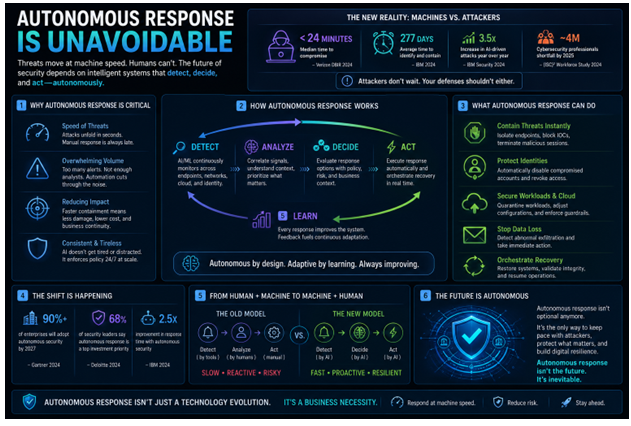
Autonomous response is unavoidable
As enterprises deploy more AI agents, security operations need automated response systems that can act independently. This shift is happening because attacks now multiply across systems faster than available human escalation cycles can manage.
A compromised AI workflow could:
1. Access sensitive systems
2. Trigger automation to other systems
3. Manipulate trusted agents
4. Spread within seconds
A compromised workflow like this is a problem that human approval loops alone cannot contain reliably.
Darktrace case study:
Darktrace's Autonomous Response technology shows how self-defending systems are already moving from theory into real-world environments when deployed.
This technology has been deployed across organizations to contain suspicious activity automatically, even before security teams can intervene.
The platform can temporarily restrict device communications, slow network activity, and limit lateral movement while human analysts investigate.
Instead of many systems that simply generate alerts, the system actively defends it by taking immediate actions to protect itself.
This is a significant shift from monitoring-based security toward autonomous defense architectures.
The rise of adaptive defense frameworks:
Static cybersecurity architectures struggle in environments where:
- AI agents evolve behavior
- Workflows change
- Systems can coordinate
- Threats adapt in real time
This is driving interest in adaptive defense frameworks (ADF), security architectures designed to grow and change continuously along with the systems they protect.
Core principles behind adaptive defense:
- Behavioral monitoring
- Policy enforcement
- Autonomous remediation
- Contextual trust evaluation
- Self-adjusting security controls
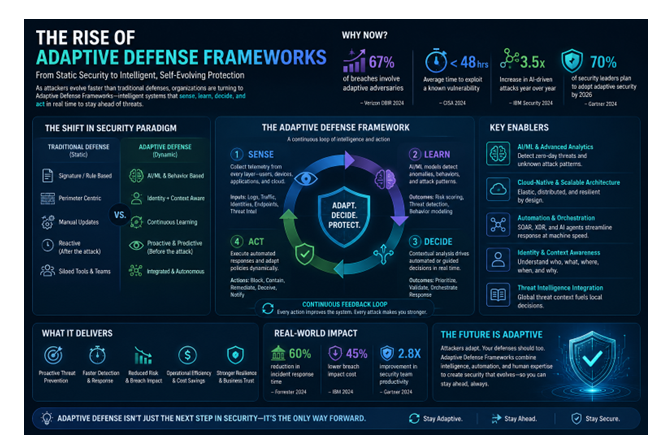
Instead of relying entirely on predefined rules, adaptive systems continue to interpret operational behavior and adapt their defenses dynamically.
This has caused a major shift from perimeter security to behavioral security, static controls to adaptive governance, and human-centered defense to autonomous resilience.
Cybersecurity, which used to focus heavily on monitoring, detection, and human-led response, is changing because future attacks and failures are happening faster than humans can respond in time.
We are witnessing a transition from reactive security toward autonomous resilience. Enterprises know now that visibility alone is no longer enough in AI-native environments. Also highlighted by Val Lyons in an RSAC 2026 presentation, one need to “Pursue ethical AI development that aligns with the spirit, not just the letter, of laws placing dignity and agency at the core.”
The future of cybersecurity will not be defined by how smart new systems and models are. It will be defined by how they can survive. This will be the last shift in the AI security evolution leading from detecting attacks, understanding behavior, to building systems that can defend themselves at machine speed.