
- Enterprises need a centralized control point for AI access, policy enforcement, logging, privacy, and security.
- AI gateways started as simple Large Language Model (LLM) API proxies. They are turning into broader control planes for LLMs, Model Context Protocol (MCP) servers, agent tools, and emerging agent-to-agent protocols.
- The newest gateways add intelligent model routing, Data Loss Prevention (DLP), semantic inspection, prompt-injection detection, behavioral analysis, and audit controls. That combination is why they are becoming a natural fit for enterprise security and compliance teams.
AI Agents Are Becoming an Enterprise Priority
AI adoption is moving fast, and it has landed squarely on the desks of both Chief Financial Officers (CFOs) and Chief Security Officers (CSOs). The newest models consume a lot of tokens, so many organizations are hunting for ways to bring down what they spend on LLMs. CSOs have a parallel worry: making sure employees aren't handing confidential data to unsanctioned model providers or to rogue MCP servers floating around the internet. So enterprises are facing a cost problem and a security problem at the same time, often from the same source. This article looks at how enterprise gateways are becoming the standard answer to both.
Why Enterprises Need AI Gateways
The market now includes a wide range of commercial and open source models, and the price gap between the two camps is significant. Open source models are also closing in on frontier-model capabilities within just a few months of release. Given that, enterprises want to pick whichever model fits a given job best, balancing cost against performance. The trouble is that switching between models, and giving people access to a growing list of them, creates real, operational and security headaches:
- Every provider has its own Application Programming Interface (API), Software Development Kit (SDK), authentication method, and logging format.
- There's little central visibility into who is using which model and why.
- Enforcing consistent authorization, rate limits, and cost controls across providers is hard.
- Fallback, retry, caching, and routing behavior aren't standardized.
- Sensitive data can end up sent to the wrong model or an external service by accident.
- There's no single audit trail spanning users, applications, agents, tools, and model providers.
AI gateways solve this by sitting in the middle, as a shared enforcement, routing, security, and observability layer between enterprise users, applications, agents, models, tools, and data sources.
The Evolution of AI Gateways
AI gateways began life as API gateways repurposed for LLM traffic. Their job at the outset was straightforward: give teams one interface across multiple model providers, track usage, manage costs, and keep things reliable.
That job has grown. Gateways now function more like an AI data plane, deciding whether a request is even allowed, which model should handle it, whether the underlying data is safe to send, and which tools an agent is permitted to call. They also handle cost, logging, and how failures and fallbacks get managed.
It helps to think of this evolution in three phases: LLM gateways, MCP gateways, and agentic gateways.
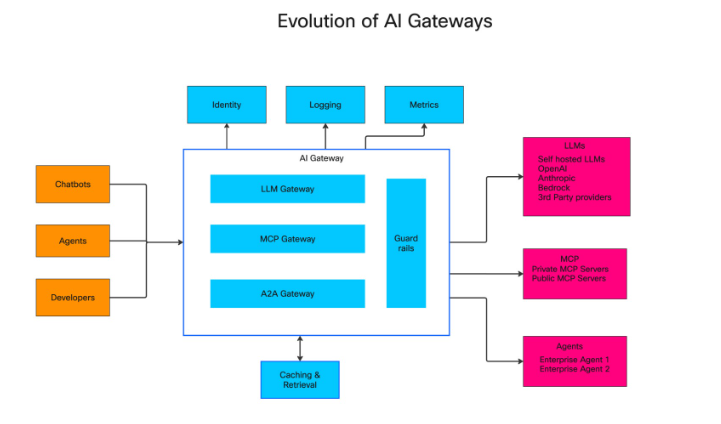
Figure: AI gateways provide a central control point across chatbots, agents, developers, LLMs, MCP servers, enterprise agents, guardrails, identity, logging, metrics, and caching and retrieval.
Phase 1: LLM Gateways
The earliest gateways were built to answer basic operational questions:
- Who is using which model?
- How many tokens are being consumed?
- Why is latency high?
- Which provider is failing?
- How should requests be retried, cached, or routed?
These gateways live between applications and AI providers, handling analytics, rate limiting, caching, retries, routing, provider abstraction, and centralized logging. They also cut down on provider lock-in by putting one API surface in front of many providers.
OpenAI-compatible APIs have become a common integration point at this layer. Several open-source projects and hosting platforms now support OpenAI-compatible endpoints, which makes it easier for enterprises to route work across commercial, open-source, and privately hosted models without rewriting integration code every time.
At this stage, the gateway's job is mostly about model access, reliability, cost, and visibility.
Phase 2: MCP Gateways
As agents matured, they needed access to data scattered across many different systems, and traditional API access wasn't built for the kind of fine-grained permissions and identity checks that agents require. MCP has emerged as a common standard for how AI applications and agents reach external tools, Software as a Service (SaaS) platforms, data sources, and internal systems. MCP servers expose their capabilities as tool calls, so an agent can pull information, take action, and interact directly with business systems.
That shift changes what a gateway has to do. It's no longer just governing model calls; it now has to govern tool access too.
An MCP-aware gateway helps enterprises answer questions like:
- Which users or agents can invoke a specific tool?
- Which SaaS systems is an agent allowed to touch?
- Should read actions and write actions go through different approval policies?
- Can an agent reach only internet-hosted MCP servers, or also servers inside a private customer network?
- Which tool calls need to be logged for audit, compliance, or incident response?
- What can be discovered through MCP server discovery, and who should see it?
This matters because agents pair model reasoning with real tool execution. Without a gateway in place, enterprises have no consistent way to watch or control what agents actually do across SaaS platforms, internal apps, and private data sources.
Phase 3: Agentic Gateways
The newest gateways are tackling agent-specific risk on top of smarter routing. Intelligent model routing sends each request to whichever model fits the task best. Agentic risk goes further than typical API security, since agents interpret natural language, work with unstructured data, and decide on their own, at runtime, which tools to call.
Agentic gateways are picking up controls such as:
- Prompt-injection detection.
- Semantic inspection of prompts and responses.
- DLP integration to catch and redact sensitive data.
- Behavioral analysis across multistep agent workflows.
- Policy enforcement for tool use, data access, and model routing.
- Audit trails linking user identity, prompts, tool calls, model responses, and whatever action followed.
These capabilities are what turn an AI gateway into a real enforcement point. A gateway can check a request before it reaches a model, review a response before it goes back to the user, and approve or block a tool call before an agent acts on it.
The Gateway as a Single Control Point
The real payoff of an AI gateway isn't that it makes model access easier, though it does that too. It's that it gives an enterprise one control point across the entire AI interaction path: users accessing AI applications, applications calling LLMs, agents invoking MCP tools, requests getting routed intelligently, different users landing on different models, and AI workflows generating actions that need to be auditable later.
Why This Converges with SASE and SSE
Secure Access Service Edge (SASE) and Security Service Edge (SSE) platforms already handle secure access to enterprise applications, data, internet services, and SaaS platforms. AI traffic is quickly becoming just another category that needs the same treatment: identity checks, policy enforcement, inspection, logging, data protection, and threat prevention. As agents get more deeply wired into enterprise systems, AI gateways are turning into another piece of that same secure access fabric.
AI gateways started out solving a fairly narrow problem: how to route LLM requests across different providers. They're turning into something much bigger, a control layer that spans models, tools, agents, data, and policy. Enterprises want to adopt AI without giving up control over access, privacy, cost, security, and compliance, and that's what's pushing this shift. As agents gain the ability to call tools and act on business systems, the gateway is becoming the natural place to enforce policy, watch behavior, and keep a reliable record of what happened.